How Can Small Businesses Build a Consistent Brand Identity with AI?
Learn how small businesses can use AI to create a consistent brand identity, with a practical Desert Oasis Ice Cream example covering logo generation, design refinement, and Brand Kits.
Last updated:
How Can Small Businesses Build a Consistent Brand Identity with AI?
Small businesses can build a consistent brand identity with AI by generating logo concepts, refining a visual direction, establishing brand colors and typography, and applying those elements across websites, social media, and marketing materials. An AI logo generator like LogoAI supports this workflow by helping businesses move from a simple brand name to original logo concepts and coordinated brand assets.
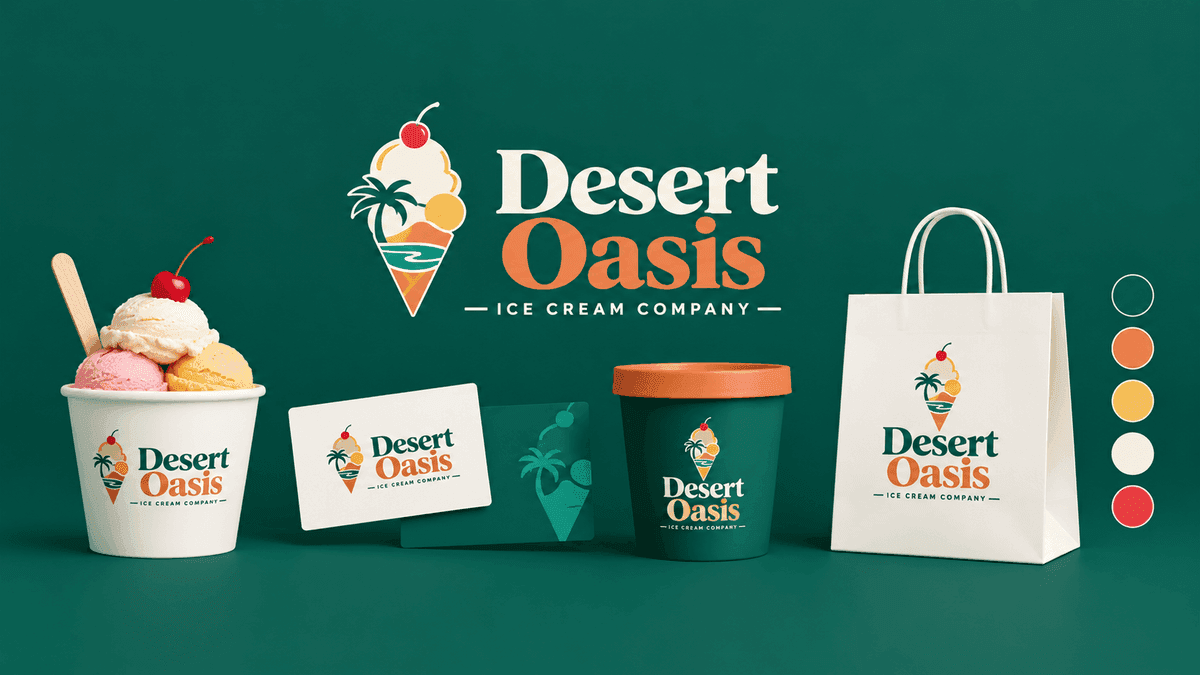
Consider Desert Oasis Ice Cream, an example ice cream brand created with LogoAI. Starting with the business name, the tool generates multiple logo concepts that explore different combinations of typography, colors, and visual symbols. These concepts provide a starting point for choosing a recognizable identity that can later be extended into a broader brand system.
The important distinction is that generating a logo is only the first stage. Consistent branding also requires decisions about which elements to preserve, how they should appear across different platforms, and how the business will reuse them as it grows.
How Can AI Turn a Business Name into a Consistent Brand Identity?
Creating a brand identity involves several connected decisions. A logo establishes a recognizable visual starting point, but the colors, typography, layout, and marketing assets must also work together.
AI can help small businesses approach these tasks as a connected workflow rather than a series of unrelated design projects.
Step 1: Generate Logo Concepts from a Business Name
Many small-business owners understand their products and customers but may not know how to translate those ideas into a visual design.
Traditionally, this might involve preparing a design brief, researching styles, or testing different templates. AI can make the initial exploration more accessible by allowing users to begin with basic brand information.
For example, LogoAI generates six different logo concepts for Desert Oasis Ice Cream.
The results explore several visual directions:
- Typography-focused designs: Bold lettering makes the business name the main visual feature.
- Illustrative concepts: Ice cream cones, cacti, and palm trees connect the product with its desert-inspired identity.
- Minimal line-art designs: Simpler illustrations create a lighter, more understated impression.
- Badge-style compositions: Framed symbols and lettering suggest a more traditional, handcrafted brand personality.
Despite sharing the same business name, these concepts communicate different impressions.
The bold typographic direction may be easier to recognize from a distance, while the detailed illustrated designs could work well on packaging or promotional materials.
This is one of the practical benefits of AI-assisted logo exploration: business owners can compare different visual approaches before deciding which elements should represent their brand.
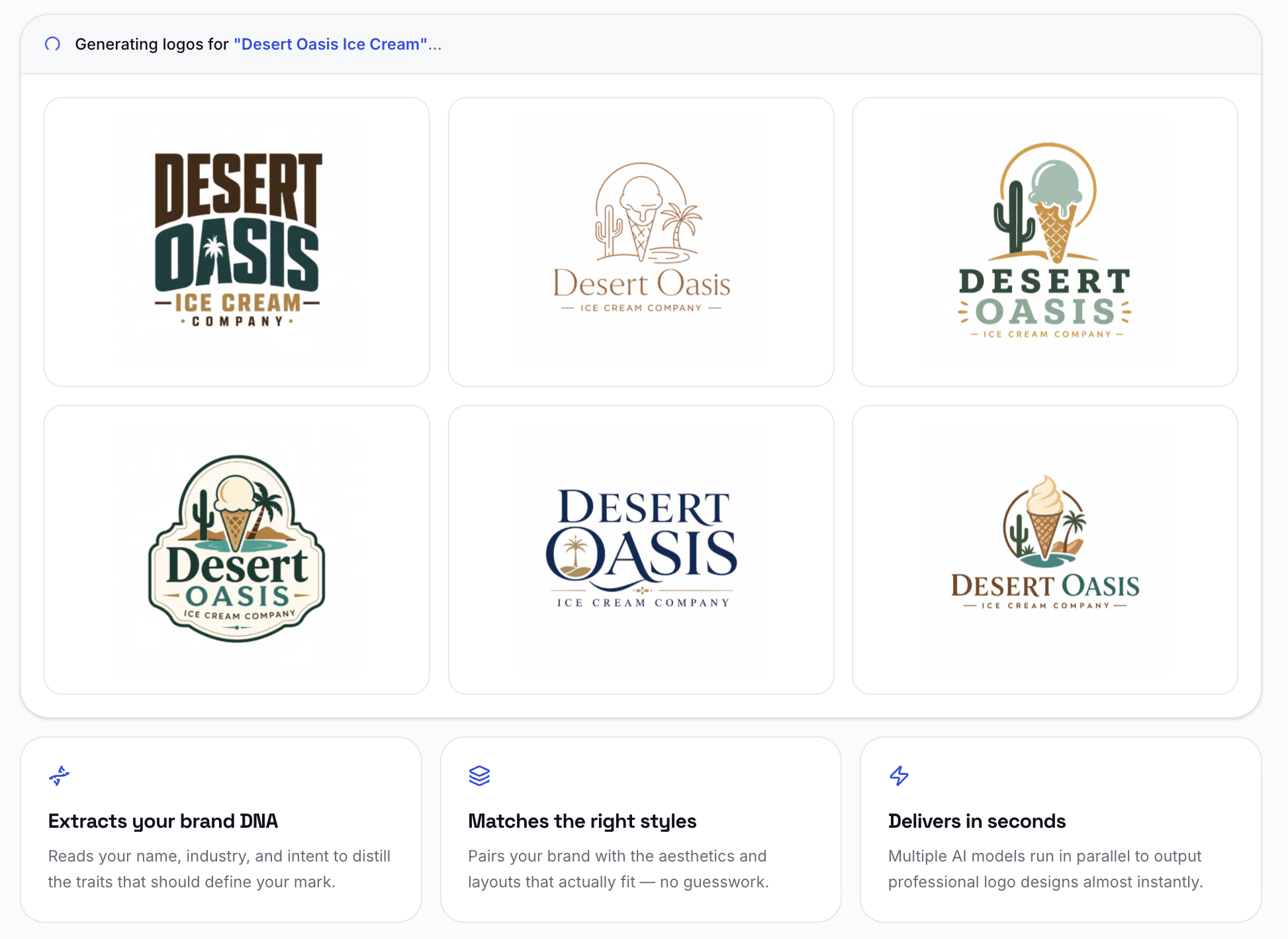
Six logo concepts generated with LogoAI for Desert Oasis Ice Cream, showing different approaches to typography, illustration, symbols, and layout.
Step 2: Refine the Logo Before Creating Other Brand Assets
Generating multiple options is useful, but choosing one does not mean the design process is finished.
For Desert Oasis Ice Cream, a business owner might prefer the typography of one concept but the illustrated ice cream symbol of another. They may also want to simplify decorative details or adjust the colors to improve readability.
LogoAI offers refinement options for elements such as typography, colors, layouts, icons, and styles.
These controls allow users to explore changes to a selected concept rather than automatically starting a completely new design.
This matters because a recognizable brand depends on preserving visual continuity.
For instance, if Desert Oasis chooses a logo featuring an ice cream cone and cactus, the business may want to keep that combination as a recurring brand symbol while adjusting the lettering for different applications.
The key is to identify which visual elements are essential to recognition and which can be modified without changing the overall identity.
AI-assisted refinement provides flexibility, but the results still require review. Important lettering, shapes, and proportions should be checked after each significant modification.
Step 3: Extend the Logo into a Brand Kit
A logo may look polished on a white background but behave differently when placed on a website, packaging, or social media profile.
Different platforms require different dimensions, layouts, and background treatments. Using one logo file everywhere can lead to inconsistent results.
This is where a Brand Kit becomes useful.
Instead of treating the logo as an isolated graphic, a Brand Kit organizes related elements into a visual system.
LogoAI's branding interface illustrates several components of this process:
- Color systems: Coordinated palettes for maintaining consistent brand colors.
- Typography: Display and body font pairings that support a unified visual style.
- Brand previews: Examples showing how branding may appear in realistic digital environments.
- Social assets: Materials designed for different social media placements.
- Brand videos: Animated applications that extend the visual identity into motion.
- Export formats: Options including SVG, PNG, and PDF for different design applications.
A separate LogoAI example, Groceries on Wheels, demonstrates these features through a live website preview, coordinated colors, typography, and other brand assets.
For Desert Oasis Ice Cream, the same type of brand system would help organize the selected logo, define reusable colors, and establish a consistent direction for packaging, menus, and online marketing.
The value of a Brand Kit is not simply having more design files. It is giving the business a common set of visual elements to work from.
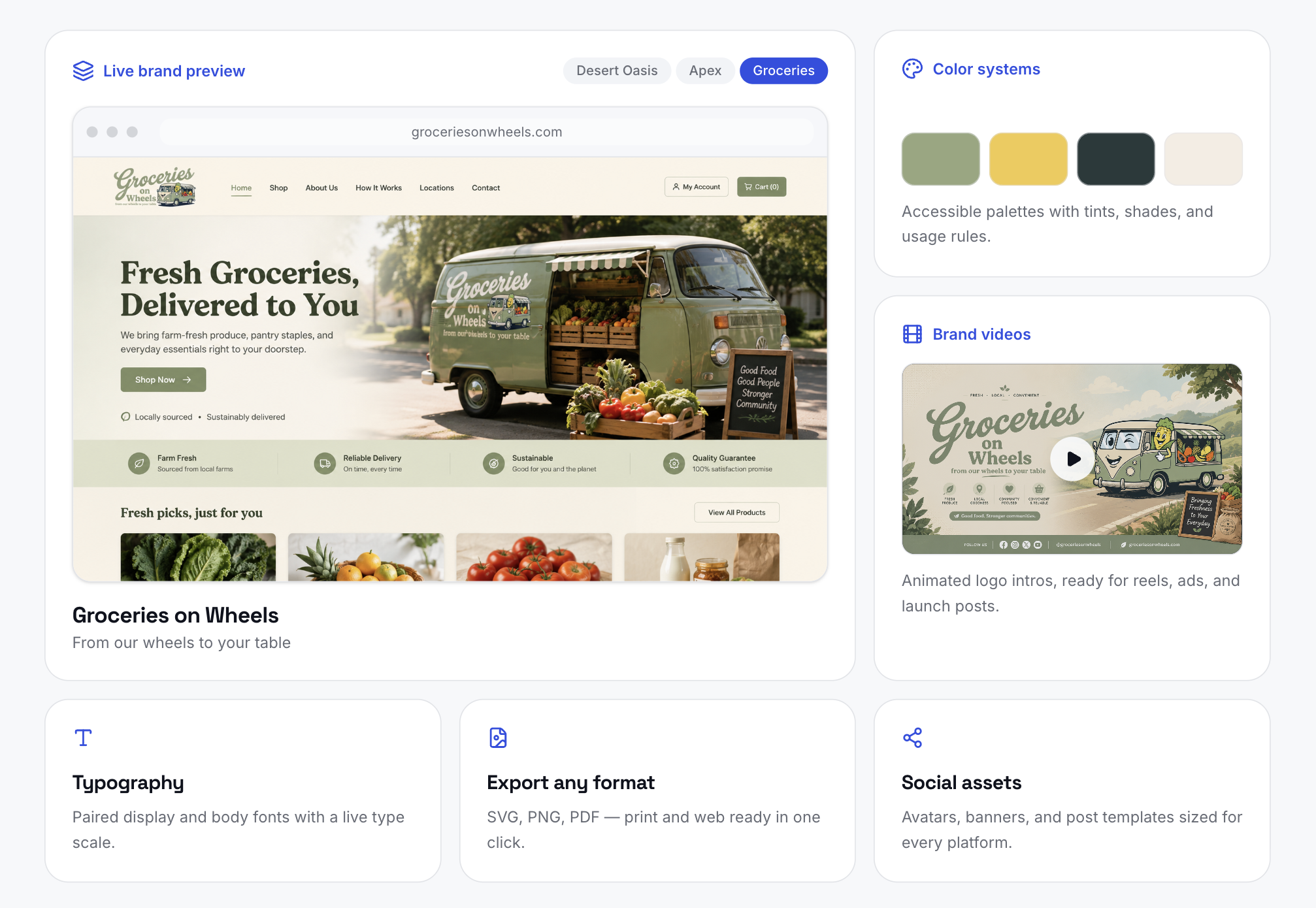
LogoAI's Brand Kit interface featuring Groceries on Wheels, a separate example showing coordinated brand colors, website previews, typography, social assets, and other branding applications.
Step 4: Apply the Brand Identity Across Different Channels
Creating coordinated assets is only part of the process. A small business must also decide how to use them consistently.
For Desert Oasis Ice Cream, the same visual identity might appear in several places:
The designs do not need to be identical.
An ice cream cup may use a compact symbol, while a website header may use the full business name. Both can belong to the same visual identity if they retain recognizable elements.
This is the difference between creating a logo and building a usable brand system.
What Makes an AI-Generated Brand Identity Consistent?
AI can generate multiple designs, but brand consistency depends on which visual elements a business selects and how it uses them.
Three factors are particularly important.
1. A Recognizable Visual Foundation
A brand needs visual elements that customers can repeatedly associate with the business.
For Desert Oasis Ice Cream, possible identifying elements include its name, desert-inspired illustrations, and a distinctive combination of colors and typography.
However, not every feature in the initial logo concepts should become a permanent brand element.
The business needs to select a coherent direction.
For example, combining every cactus, palm tree, decorative border, and illustration from the six generated options could create an overly complicated identity.
A more practical approach would be to preserve a few recognizable characteristics and apply them consistently.
This makes the identity easier to reproduce across different formats.
2. Consistent Colors, Typography, and Logo Variations
A defined visual system reduces unnecessary design decisions.
A brand color palette should identify the main colors and record their exact values so they can be reproduced across different materials.
Typography should also follow a consistent hierarchy, such as one font for major headings and another for body text.
Logo variations are equally important.
A horizontal logo may suit a website header, while a simpler symbol may work better on a small ice cream cup or social media avatar.
These variations can use different arrangements without losing the brand's recognizable identity.
For Desert Oasis Ice Cream, a compact ice cream-and-cactus symbol could be considered for smaller applications, provided it remains visually connected to the chosen primary logo.
The goal is not to repeat the exact same design everywhere. It is to preserve recognizable features while adapting to different uses.
3. Real-World Usability
A visual identity should be evaluated in realistic situations, not only in a large design preview.
For example, a detailed logo may look attractive on a website but become difficult to recognize when printed on a small product label.
Before adopting a design, small-business owners should check:
- Whether the business name remains readable at small sizes.
- Whether important symbols retain their recognizable shapes.
- Whether colors provide sufficient contrast.
- Whether the logo works on light and dark backgrounds.
- Whether different versions still look like parts of the same brand.
For digital text, the W3C's WCAG 2.2 Level AA guidelines specify minimum contrast ratios of 4.5:1 for normal text and 3:1 for large text.
These standards provide a useful reference when evaluating text colors and background combinations.
AI-generated color palettes can be a starting point, but businesses should still verify accessibility and readability before using them publicly.
What Should Small Businesses Check Before Using AI Branding Tools?
AI branding tools can make design exploration and asset creation easier, but businesses still need to evaluate the results.
Does the Design Represent the Business?
A visually appealing design is not automatically an appropriate brand identity.
For Desert Oasis Ice Cream, desert-inspired imagery creates a clear connection to the business name. However, the selected design should also communicate the intended brand personality.
A premium ice cream shop may prefer an understated logo, while a family-oriented business may benefit from a more playful illustration.
AI can generate these possibilities, but the business must decide which direction best matches its customers and positioning.
Can the Assets Be Reused as the Business Grows?
A useful brand identity should remain practical beyond the initial launch.
Imagine Desert Oasis Ice Cream introducing new flavors, opening another location, or creating seasonal promotions.
These changes will require additional packaging, signs, and marketing graphics.
If the business has an established Brand Kit, new materials can begin with approved colors, typography, and logo variations rather than requiring a new visual direction each time.
This helps preserve recognition as the business expands.
Is the Logo Suitable for Commercial Use?
AI-generated logos also require appropriate checks before commercial use.
Businesses should review the licensing terms of their design tools, verify available export formats, and assess whether their chosen logo resembles existing trademarks.
The United States Patent and Trademark Office recommends searching for potentially conflicting trademarks before applying for registration.
AI generation alone does not establish that a logo is legally unique or cleared for commercial use.
For printed materials, businesses should also confirm that their files meet the resolution and format requirements of their production providers.
These checks help distinguish an attractive logo concept from a practical, commercially usable brand asset.
Final Thoughts
Small businesses can use AI to build a consistent brand identity by connecting logo generation, design refinement, coordinated brand assets, and real-world applications.
The Desert Oasis Ice Cream example shows how one business name can lead to several distinct logo directions. The next step is to select and refine a recognizable concept, establish reusable visual elements, and apply them consistently across customer touchpoints.
LogoAI supports this broader workflow through AI-generated logo concepts, design refinement, and Brand Kit features.
The value is not simply producing multiple logos or marketing graphics. It is helping businesses create a visual foundation they can continue using as their needs evolve.
AI can make that process more accessible, while business owners remain responsible for choosing the right identity, checking its usability, and maintaining consistency over time.